
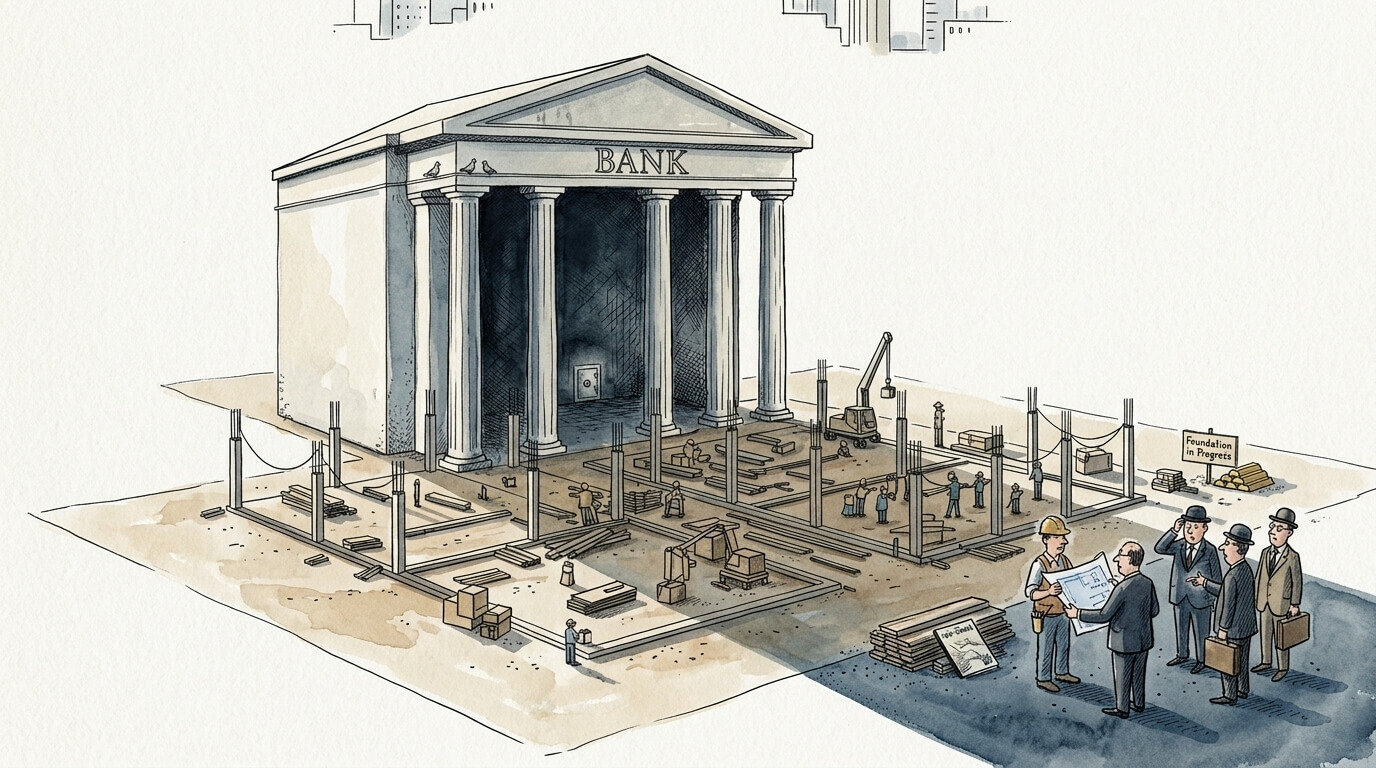
There’s a number buried in the latest AD&C lending data that most builders will scroll right past. It deserves a second look.
Banks with more than $250 billion in assets hold just 9.9% of construction loans in the United States.
Pause on that for a moment.
These are the institutions that control roughly 60% of the American banking system. Yet, when it comes to financing the homes the country needs, they are, for all practical purposes, absent from new-construction financing.
So who is actually lending to builders? Regional banks and community banks.
Institutions with $1 billion to $10 billion in assets hold 35.3% of all construction loans. Mid-sized banks pick up another 33%. The entire construction lending ecosystem is built on the shoulders of smaller, more vulnerable institutions.
That’s not just an interesting footnote. It’s the structural fault line running underneath every builder’s capital stack right now.
How We Got Here
It didn’t used to be this way.
Before 2008, construction lending was a core segment of commercial banking. Banks competed aggressively for builder relationships. Loan-to-cost ratios were generous. Spec financing was widely available. At its peak in early 2008, residential construction lending hit approximately $204 billion.
Then the crash came.
It hit construction portfolios harder than almost any other category. Hundreds of regional banks failed. Regulators responded with strict CRE concentration limits and heightened scrutiny of construction portfolios.
Internally, construction lending was reclassified at many institutions as high-risk capital. Some banks exited the category entirely and never came back.
Here is the number that should stop every builder cold: residential construction lending today remains 56% below its 2008 peak. Not 56% below an inflated bubble number from a reckless era—56% below the baseline that once supported a functioning homebuilding industry.
Demand recovered. Construction credit did not.
Why This Matters Right Now
The regional banking sector has been under sustained pressure since the bank failures of 2023.
Tightening CRE concentration limits and heightened regulatory scrutiny have made construction lending even less attractive on their balance sheets.
These are not abstract regulatory concerns. They translate directly into lower leverage, stricter underwriting, slower approvals, and fewer available construction lines—for builders who are already operating in a supply-constrained market.
The instinct many builders carry is that when housing demand rises, financing will follow. The last fifteen years have demonstrated that this assumption is no longer reliable. Demand and capital no longer move in lockstep. The gap between them is real and widening.
The Shift Already Underway
Builders who are navigating this environment successfully aren’t waiting for regional banks to return to their pre-2008 appetite. They are restructuring their capital stacks around the institutions that have stepped into the void: private debt funds, insurance-backed capital, equity partners, and specialty construction lenders.
This is not a workaround. It is the new architecture of construction finance. The builders who recognize this early—and build relationships with alternative capital sources before they need them — are the ones who will have access to capital when a deal needs to move.
The U.S. housing shortage is a demand story, a regulatory story, and a labor story. But it is also, quietly and persistently, a capital story.
The system that once financed builders at scale was dismantled after 2008. What replaced it is smaller, more fragmented, and more susceptible to the kind of institutional pressure the regional banking sector is facing right now.
Understanding that isn’t pessimism. It’s the foundation of a smarter financing strategy.
