



If you’re building a home to keep as a rental, the construction loan is only half of your financing plan. It pays for the build. Once the home is finished, you must replace that short-term debt with something designed for long-term ownership.
For many builders and investors, that’s a Debt Service Coverage Ratio (DSCR) loan. A DSCR loan qualifies the property mainly on its rental income, not your personal income. Refinancing a construction loan into a DSCR loan turns a finished project into a long-term, income-producing asset.
Key Takeaways
- Rent usually sets the loan amount. The appraisal tells you the most a lender could lend. The rent often decides how much you actually get.
- The property has to be finished. Completion, inspections, occupancy approval, and lien releases come before permanent financing.
- Run the numbers early, and run them conservatively. Realistic rents, today’s rates, and a cushion for delays protect you at maturity.
- One lender for both loans reduces risk. A lender who finances the build and the hold knows the project before the refinance begins.
Why Refinance a Construction Loan Into a DSCR Loan?
A construction loan is designed for the building period. It has a short term, it carries interest-only draws, and it comes due when the project is complete. That works well when the plan is to sell. When the plan is to keep the home, the debt has to change along with the purpose.
A DSCR loan replaces short-term construction debt with financing built for ownership. Instead of underwriting your tax returns and W-2s, the lender focuses on whether the home’s rent covers its monthly housing payment. You keep the asset, collect rent, build equity over time, and keep your personal income profile out of the qualification. For builders who want to keep growing, that can free up borrowing capacity for the next project.
Why one lender for both loans helps
Most refinances involve a handoff. One lender funded the build, and a different lender now has to learn the property from scratch: the budget, the draw history, the delays, the final value. Every unknown is another chance for the numbers to change late in the process.
When the same lender finances both the construction and the hold, that handoff goes away. The team underwriting your DSCR loan already knows the project because they funded it. That’s how Sound Capital approaches build-to-rent financing: we plan the exit as we structure the construction loan, so there are no surprises at maturity.
For a closer look at how the two products differ, read Construction Loan vs. DSCR Loan: What’s the Difference?
How to Refinance a Construction Loan Into a DSCR Loan: 5 Steps
Every lender sets its own guidelines, but the path from construction to permanent rental financing usually follows the same five steps. To keep the math concrete, we’ll follow one property all the way through: a newly built rental home that appraises at $500,000, rents for $3,500 a month, and has a $340,000 construction loan balance.
Step 1: Finish the build and get the property rent-ready
A DSCR lender finances a rental, not a job site. Before the refinance can close, you’ll need a certificate of occupancy or the local equivalent, final inspections, and proof that subcontractor and supplier liens have been cleared. The home needs landlord insurance in place and an appraisal of its completed value.
Some programs require a signed lease. Others will accept the appraiser’s market rent estimate for a vacant property. Know which applies before you finish the build, because it affects how quickly you need a tenant.
For the full list of requirements, see DSCR Loan Requirements: What Builders and Investors Should Know.
Step 2: Establish the rent
Rent drives DSCR qualification, so the lender needs a number it can defend. That usually comes from an executed lease, a market rent analysis included in the appraisal, or both. Lenders often use the lower of the two.
Short-term rentals are underwritten differently. Lenders may rely on historical booking data or approved market projections, and not every program accepts them. If you’re building for short-term use, confirm eligibility before you design the property.
In our example, both the lease and the appraiser support $3,500 a month.
Step 3: Calculate the debt service coverage ratio
DSCR compares the property’s qualifying monthly rent with its full monthly housing payment: principal, interest, taxes, insurance, and any association dues.
DSCR = Qualifying Monthly Rent ÷ Monthly Housing Payment
Suppose you borrow just enough to pay off the $340,000 construction loan on a 30-year term at 7.25%:
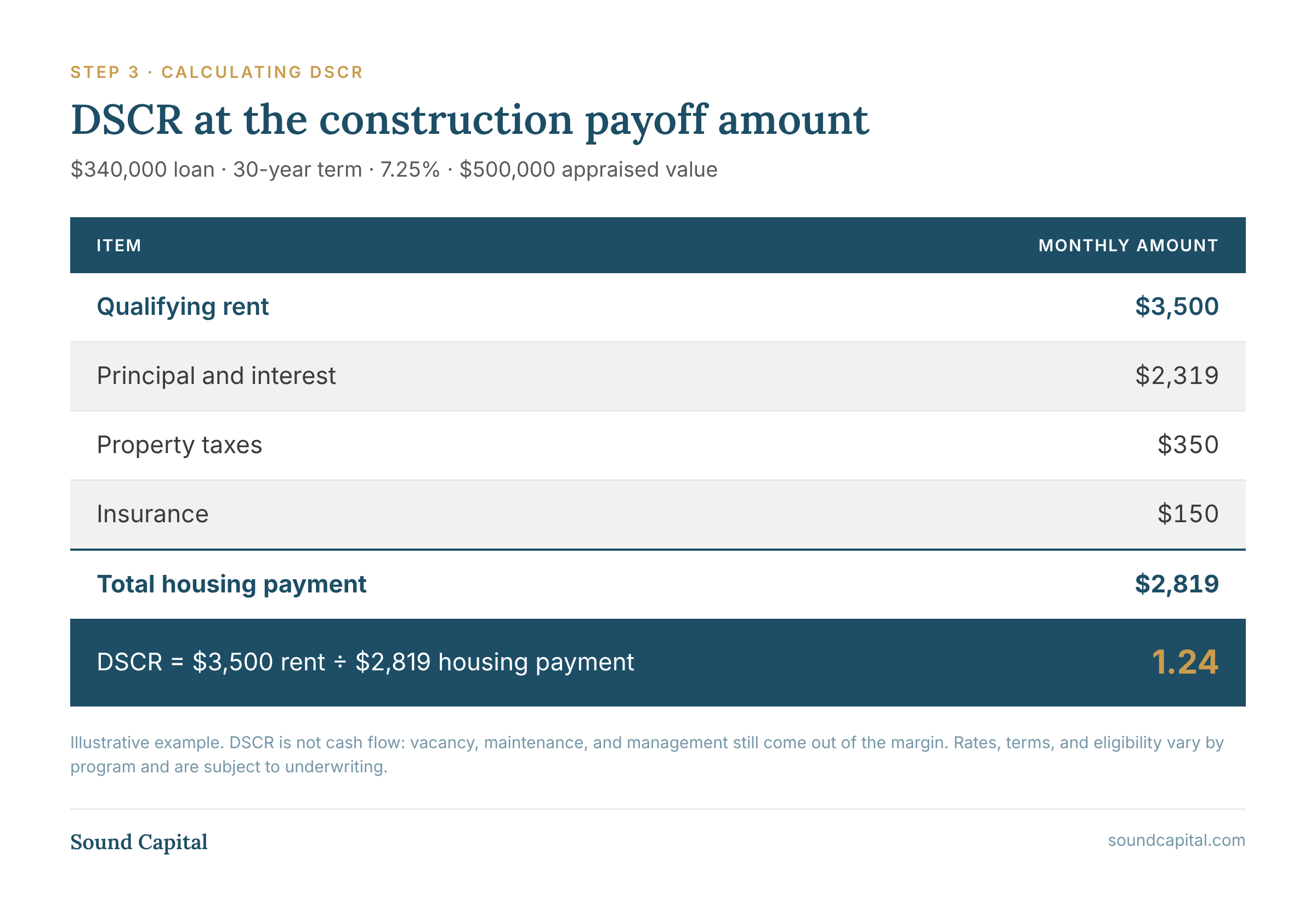
A DSCR of 1.24 means the rent covers the housing payment with 24% to spare. That’s a healthy ratio for many programs, but DSCR isn’t cash flow. Vacancy, maintenance, management, and capital repairs still come out of that margin, so budget for them separately.
For a deeper walkthrough, see How to Calculate DSCR: A Guide for Builders and Real Estate Investors.
Step 4: Find out what actually limits the loan
The appraisal sets the ceiling. At a 75% loan-to-value limit, our $500,000 home could support a loan of up to $375,000, which looks like $35,000 of room above the construction payoff.
The rent tells a different story. Here’s the same property at both loan sizes:
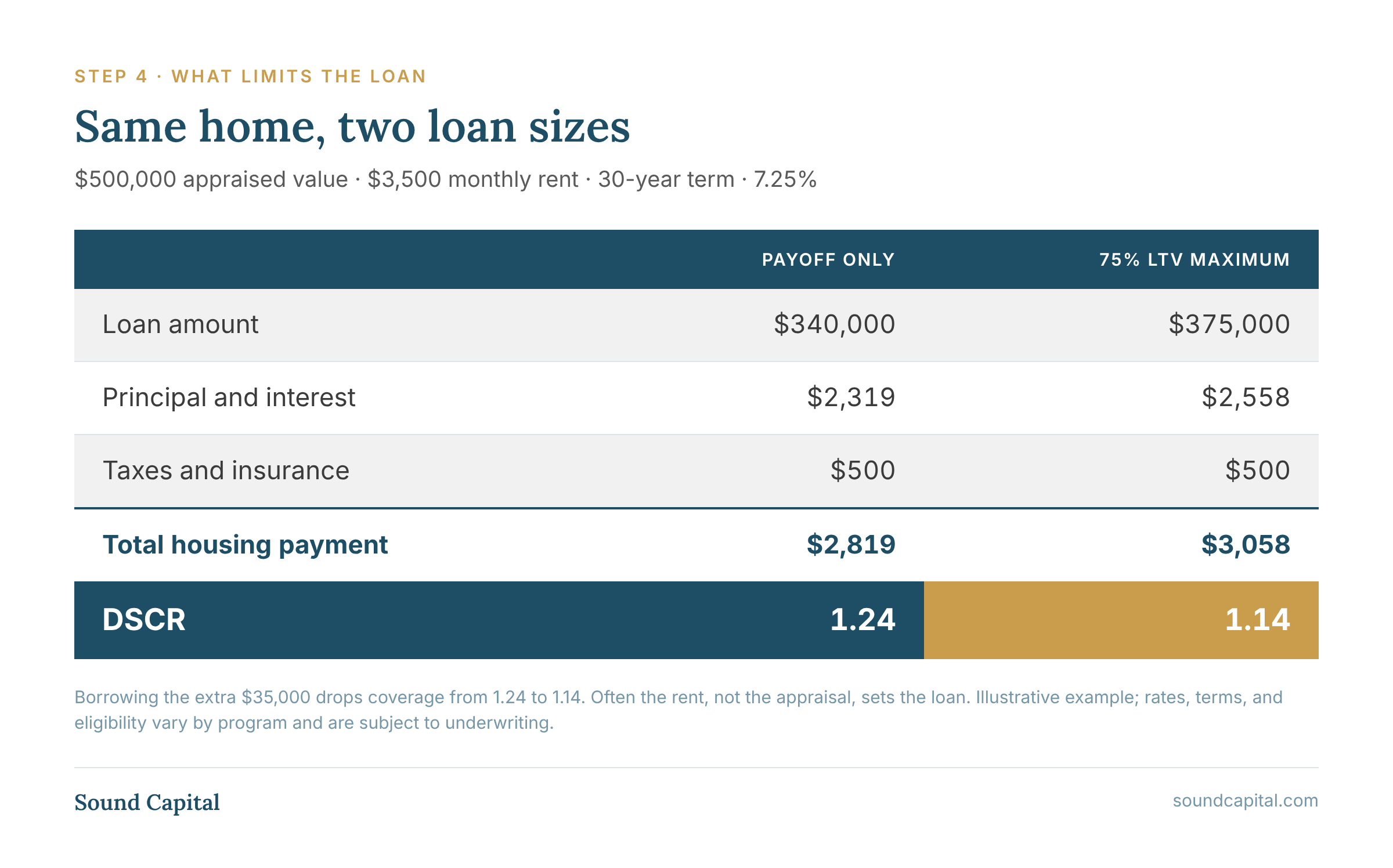
Borrowing the extra $35,000 drops coverage from 1.24 to 1.14. If a program’s minimum were 1.20, the rent, not the appraisal, would cap this loan. That’s common in build-to-rent financing, and it’s the main reason to run the DSCR at your target loan amount, not just the LTV.
Two more points. First, even the payoff-only loan doesn’t cover closing costs, so plan to bring cash or size the loan slightly higher if the ratio allows. Second, some lenders apply seasoning rules or cash-out limits to newly completed homes. Ask early if you’re counting on pulling equity out.
Step 5: Apply and close
With the property complete and the numbers in range, you’re ready to apply. The lender will review the appraisal and rent documentation, the construction loan payoff statement, your credit and reserves, and the title and insurance on the finished home.
At closing, the DSCR loan proceeds pay off the construction loan, and you move to the new loan’s long-term payment schedule. If the same lender handled the construction loan, much of that documentation is already on file.
For more on underwriting, read How a DSCR Loan Actually Gets Approved.
When Should Builders Start Planning the DSCR Refinance?
Before construction begins. This is where the intent to hold becomes real. A refinance planned at the start can be shaped around the rent, the finish level, and the payoff you’ll need. A refinance attempted after a failed sale has to fit whatever the market will give it.
Before you break ground on a home you plan to keep, answer five questions:
- What will this home realistically rent for, based on comparable rentals rather than comparable sales?
- How large a permanent loan will you need to pay off the construction loan, including closing costs?
- What completed value does that loan require?
- At today’s rates, taxes, and insurance, does the DSCR still work at that loan amount?
- If the numbers come in light, where does the difference come from?
If the answers work on conservative assumptions, you have an investment strategy. If they only work on optimistic ones, you have a spec home with a backup plan, and that’s a harder refinance.
Common Challenges When Refinancing Construction Into DSCR
Even well-planned projects can hit friction at the finish line. Rents come in below projections, and the DSCR shrinks the loan. A low appraisal lowers the LTV ceiling and increases the cash you need to retire the construction loan. Construction runs long, which compresses the time between completion and maturity, the window when you need the refinance to close. Rates or guidelines can change between groundbreaking and completion, sometimes enough to move the ratio. See Current DSCR Loan Rates: What Affects Pricing and Loan Terms
None of these is unusual. Each one is manageable when the plan includes a cushion, and much harder when it doesn’t.
Frequently Asked Questions About Construction-to-DSCR Refinancing
Can I refinance into a DSCR loan immediately after construction?
Often, yes. Some lenders allow it as soon as the property is complete and rent-ready. Others impose seasoning periods, especially for cash-out refinances.
Do I need a tenant before refinancing?
Not always. Some programs accept the appraiser’s market rent for a vacant home. Others require a signed lease.
Do I need W-2 income to qualify?
No. DSCR loans qualify mainly on the property’s rent. Lenders still review your credit, reserves, and experience.
Can I use a DSCR loan for a newly built short-term rental?
Sometimes. Sound Capital’s DSCR program considers eligible short-term rentals, though income documentation and valuation differ from long-term rentals.
What if the DSCR loan won’t fully pay off the construction loan?
You’ll need to cover the difference with cash or pursue other financing. Running the DSCR at your target loan amount before construction begins is the best way to avoid that situation.
Build the Hold Into the Plan
Building a home and owning a rental are two different financial commitments. Builders who handle the transition well treat them as one plan, with exit financing settled before the first draw.
Sound Capital has funded more than $3.4 billion across 3,900 projects for residential builders. Our DSCR program extends that experience past completion. The same team that finances your build can finance the hold, so the loan that pays off your construction debt starts with a lender who already knows the project.
Explore Sound Capital’s DSCR financing options or talk with Lisa Jangard about your project, your rent assumptions, and how the construction and permanent financing fit together.
Call or text Lisa directly at 253-973-4251.
Rates, terms, and eligibility vary by program and are subject to underwriting. The examples in this article are illustrative and are not a commitment to lend.