

Understanding the difference between a construction loan vs. DSCR loan starts with two questions: What stage is the property in, and what do you plan to do with it? Your answers help determine which financing fits the project and your ownership goals.
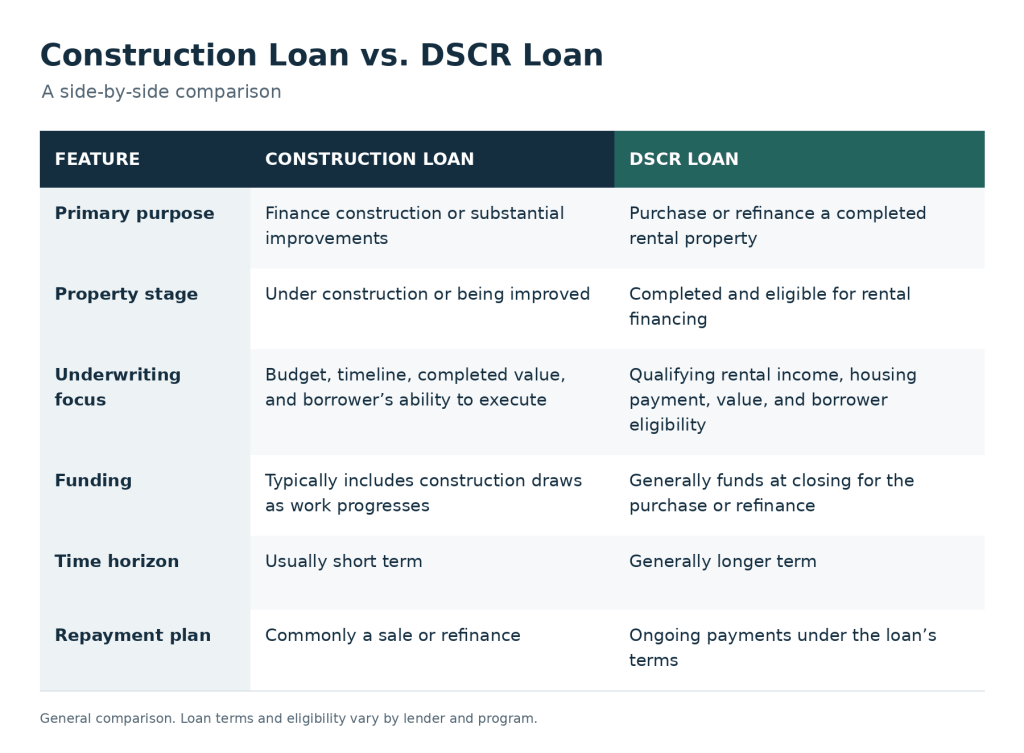
A construction loan provides capital to build or substantially improve a property. A Debt Service Coverage Ratio (DSCR) loan provides financing for a completed investment property, with qualification focused largely on its rental income relative to its required housing payment.
For builders and investors, understanding that distinction helps match the financing to the work ahead—and the ownership plan that follows.
What is a construction loan?
New home construction financing supports the work needed to complete a project. Rather than advancing the entire construction budget at closing, lenders typically release funds through draws as work progresses.
Underwriting focuses on the project and the borrower’s ability to deliver it. Depending on the lender, that may include the construction budget, plans, schedule, builder experience, equity contribution, and projected completed value.
Construction loans are generally short-term. The borrower needs a clear plan to repay the balance, such as selling the completed property or obtaining longer-term financing.
For a builder developing homes for sale, that financing serves a specific purpose: funding production until a sale repays the loan.
What is a DSCR loan?
DSCR stands for debt service coverage ratio. People commonly use these loans to purchase or refinance completed rental properties.
For many residential DSCR programs, the lender compares qualifying monthly rental income with principal, interest, property taxes, insurance, and applicable association dues. The lender’s method for establishing rental income matters, particularly for properties without an established rental history.
The property’s income plays a central role, but approval also depends on factors such as credit, property value, loan-to-value ratio, reserves, and DSCR program eligibility. DSCR financing generally serves a longer ownership horizon than construction financing. Exact terms, income requirements, and repayment options vary by lender and program.
For a closer look at the numbers, learn how to calculate DSCR and what the ratio tells you about a rental property.
The useful question is which loan fits the property’s current needs.
If you need capital to build, construction financing is the starting point. If you are purchasing or refinancing a completed property for rental ownership, DSCR financing may be an option.
Can both loans be used for the same property?
Yes. A builder developing a property for rental ownership might use construction financing during the build, then apply for a DSCR refinance after completion.
That transition requires a separate approval. Understanding how a DSCR loan gets approved can help you prepare before construction ends. Completing construction does not automatically qualify the property or borrower for a DSCR loan.
Before relying on that refinance, discuss completion requirements, acceptable rental-income documentation, ownership seasoning, appraisal treatment, and available loan proceeds with the lender.
The amount available through a DSCR loan may differ from the outstanding construction balance. If the new loan does not cover the payoff and closing costs, the borrower needs to plan for the difference.
Rental income needs to support the ownership plan
A lender’s DSCR calculation answers an underwriting question. Your operating budget needs to answer a broader one: Will the property produce an acceptable return after the costs of owning it?
Vacancy, maintenance, repairs, management, and future capital expenses can affect the outcome even when the property meets a lender’s requirements.
For a short-term rental, also account for seasonality, turnover costs, and local operating restrictions. Confirm how the lender evaluates that income before building your financing plan around projected bookings.
Choose financing that fits the project
Start with the property’s stage, your intended use, and the numbers supporting that plan. Then work backward to the financing.
Sound Capital offers construction financing and DSCR financing for eligible rental properties, including short-term rentals. Lisa Jangard can help you review your DSCR options and determine what the property and borrower need to qualify.
Call or text Lisa at 253-973-4251 to discuss your rental financing options.