



A good DSCR for a rental property is generally 1.25 or higher. At that level, the property’s qualifying rental income is 25% greater than its proposed monthly housing payment. But what counts as good depends on the lender, the property, and the financing program.
For builders and investors, DSCR matters because it helps answer two different questions. The first is whether a lender will finance the property. The second is whether the property will actually make money once it’s leased. A ratio can satisfy the first question and say very little about the second. This guide covers both.
New to Debt Service Coverage Ratio (DSCR) loans? Check out The DSCR Loan: A Builder’s Guide to Financing Homes You Plan to Keep.
Key Takeaways
- A DSCR of 1.25 or higher is generally considered strong. Qualifying rental income exceeds the housing payment by at least 25%.
- A DSCR of 1.0 means rent equals the payment, with no cushion. Many residential DSCR programs accept it, and some go lower.
- For new construction, qualifying rent usually comes from the appraiser, not from your own projection.
- You can calculate the rent a home needs before you build by multiplying the expected housing payment by your target DSCR.
- DSCR measures financing capacity, not profitability. Vacancy, maintenance, and management costs still decide what you keep.
What Is a Good DSCR Ratio for a Rental Property?
A good DSCR shows that a rental property generates enough qualifying income to cover its proposed housing payment, with room to spare. For residential DSCR loans, 1.25 is a useful benchmark, though each lender sets its own minimum.
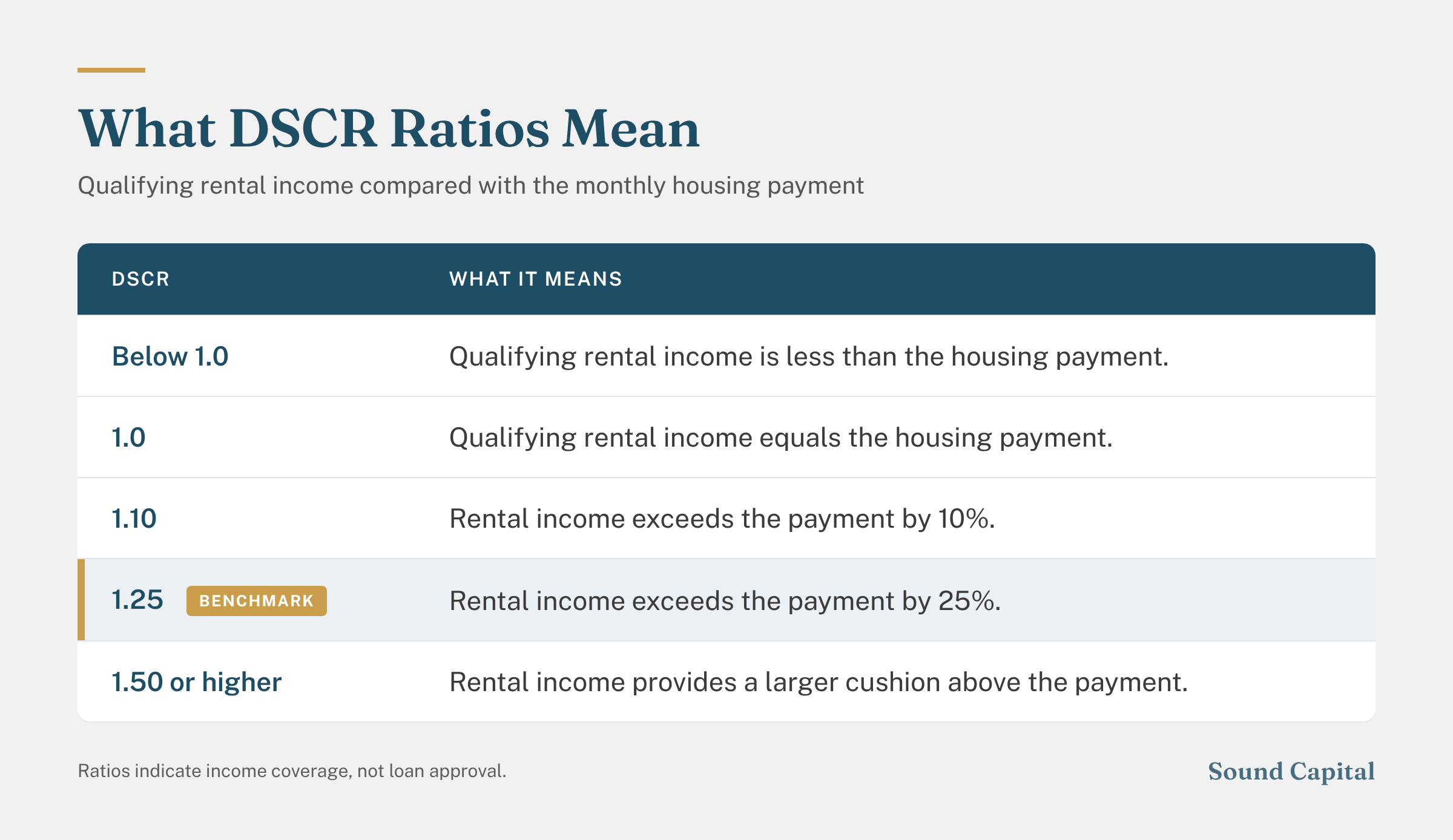
These ratios describe income coverage, not approval. A property at 1.10 might clear one lender’s minimum and fall short of another’s, and a property at 1.50 still has to meet every other underwriting requirement.
At Sound Capital, we’d rather look at your numbers than quote a cutoff in the abstract. The ratio we can work with depends on the full picture: your credit, your reserves, the loan-to-value, and the property itself. That’s why two properties with the same DSCR can receive different terms. If you’re weighing whether a home will qualify, call or text Lisa Jangard, our VP of DSCR lending (253-973-4251), to share the details, and we’ll tell you where it stands.
Where the 1.25 benchmark comes from
The 1.25 figure is borrowed largely from commercial real estate lending. There, DSCR is calculated from net operating income (rent minus operating expenses) divided by annual debt service, and lenders commonly look for 1.25 or more. Residential DSCR loans use a simpler formula that doesn’t subtract operating expenses, which is one reason many residential programs accept ratios at or near 1.0. If you’ve seen 1.25 cited as a hard minimum, it may have come from the commercial side.
How Is DSCR Calculated?
For most residential investment property loans, lenders divide qualifying monthly rental income by the proposed monthly housing payment.
DSCR = Monthly Qualifying Rental Income ÷ Monthly Housing Payment
The housing payment generally includes principal, interest, property taxes, insurance, and any homeowners association dues, often abbreviated as PITIA. Consider a newly completed rental home with these numbers:
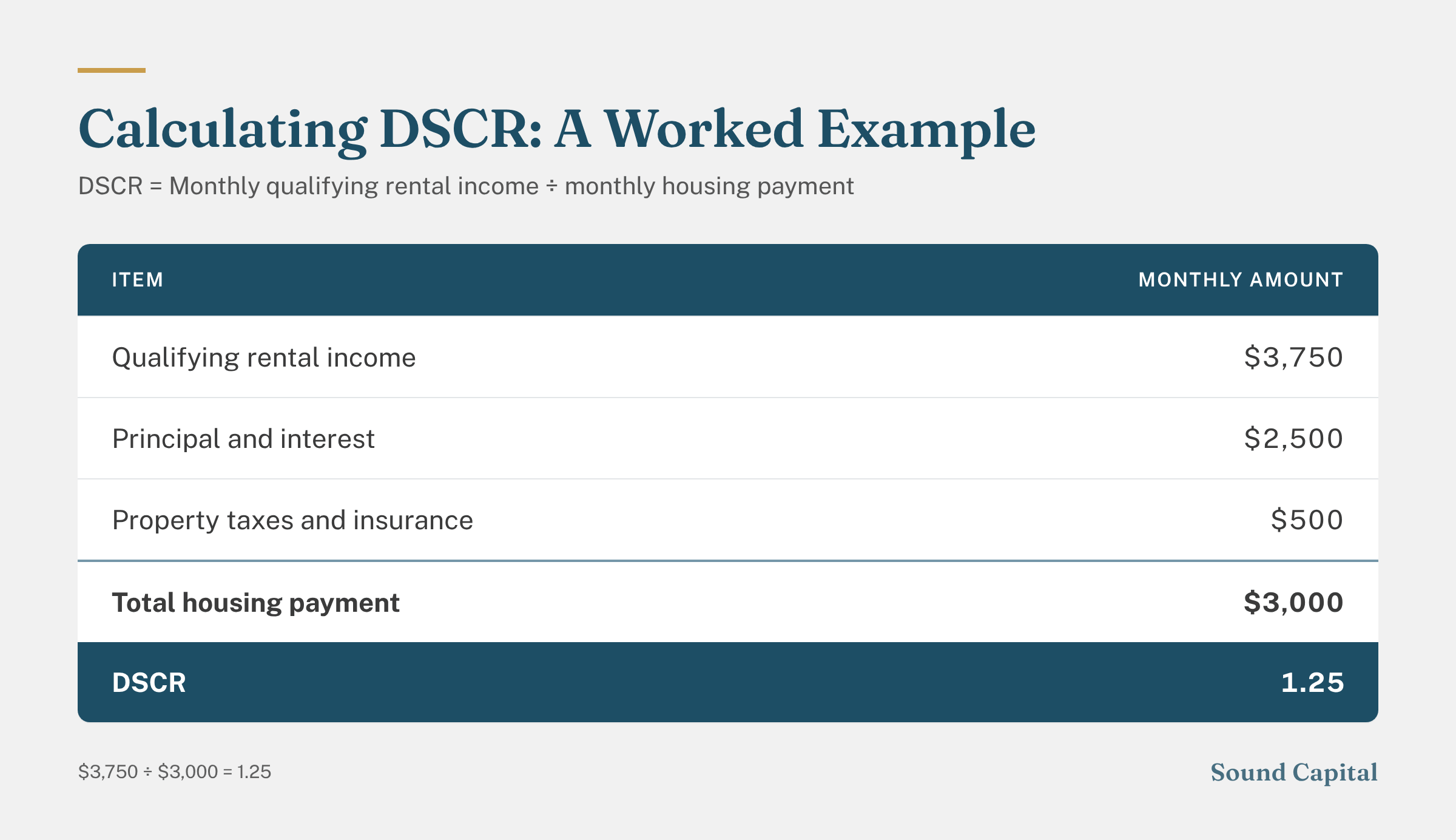
The property produces $1.25 in qualifying rent for every $1.00 of housing payment. If the same home qualified at only $3,000 a month, its DSCR would fall to 1.0: the payment is covered, but with no cushion.
For a full walkthrough of the variables lenders use, see our guide to calculating DSCR.
What Counts as Qualifying Rental Income?
This is where a builder’s projections and a lender’s numbers most often part ways.
Qualifying rental income is the rent the lender agrees to use, which isn’t necessarily the rent you expect to collect. A newly built home has no lease and no rent history, so lenders typically rely on the appraiser’s estimate of market rent, documented on a comparable rent schedule (Fannie Mae Form 1007 for single-family homes). When a property does have a lease, many lenders use the lower of the lease amount and the appraiser’s market rent.
A small gap in rent produces a big change in the ratio. Suppose you expect to lease the home in the example above for $3,750, but the appraiser’s comparables support $3,300. Against the same $3,000 payment, your DSCR drops from 1.25 to 1.10. That can be the difference between qualifying and not, or between one pricing tier and another.
The safest assumption is the one an appraiser would make: rent supported by recent leases on nearby, comparable homes, not the top of the market.
Work Backward: The Rent Your Home Needs
If you plan to keep a home as a rental, you don’t have to wait for the appraisal to see whether the numbers work. You can calculate the rent the property needs before construction starts.
Required Monthly Rent = Estimated Monthly Housing Payment × Target DSCR
Estimate the payment from your expected loan amount, interest rate, property taxes, insurance, and any HOA dues, then multiply by the ratio you’re aiming for. A home with an estimated $3,000 payment needs $3,000 in qualifying rent to reach 1.0 and $3,750 to reach 1.25.
Then compare that figure with what comparable homes in the area actually lease for. If they rent for $3,400, you know before you break ground that reaching 1.25 will take a lower payment, a different plan, or a different lot. That’s far cheaper to discover than at appraisal.
Is a DSCR of 1.0 Good Enough to Qualify?
Often, yes. A 1.0 ratio means qualifying rent equals the housing payment, and many residential DSCR programs accept it, particularly when the borrower brings strong credit, meaningful equity, or solid reserves. Some programs go below 1.0, usually with lower loan-to-value limits, higher pricing, or other restrictions. Others require more.
Clearing a lender’s minimum isn’t the same as owning a strong investment, though. At 1.0, every dollar of rent is already committed to the payment before you’ve covered a single repair, vacancy, or management fee.
Why a Higher DSCR Can Matter
A higher ratio shows the lender more income coverage, which can ease concerns about the property’s ability to carry its debt. Depending on the program, a stronger DSCR may help you qualify where you otherwise wouldn’t, access more competitive rates or terms, support a larger loan amount within other underwriting limits, and absorb a dip in rents without falling short on the payment.
DSCR is still only one part of the decision. Lenders also weigh credit history, property value, loan-to-value, reserves, and property eligibility, and a strong ratio doesn’t waive any of them. To see how these factors fit together, read How a DSCR Loan Actually Gets Approved.
Does a Higher DSCR Mean a Better Rental Investment?
Not necessarily. DSCR compares rent with the housing payment. It says nothing about the other costs of owning a rental.
Consider two properties with the same $3,000 monthly housing payment. Property A is a newly built single-family home that leases for $3,750, a DSCR of 1.25. Property B is a larger home in a higher-turnover market that leases for $4,500, a DSCR of 1.50. By the lender’s math, B is the stronger property. Here’s what happens once ownership costs enter the picture (figures are illustrative):
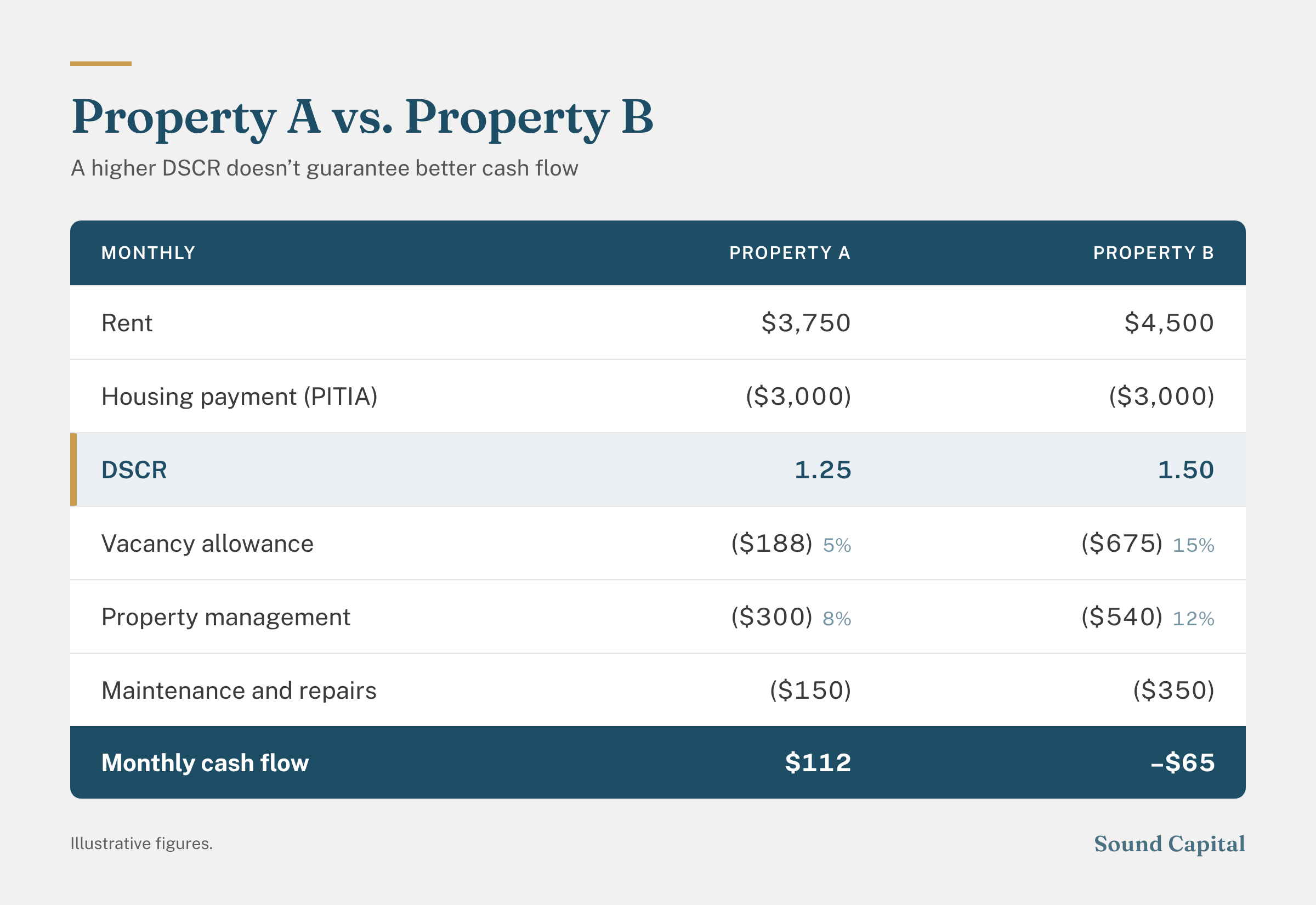
Property B has the better ratio and the weaker investment. Higher turnover, more intensive management, and a bigger home to maintain consume its extra rent and then some. This is also where new construction tends to have an edge: a home built for the rental market usually carries lower maintenance costs in its early years than an older property.
The lesson isn’t that DSCR is misleading. It answers a narrower question. The ratio tells you whether the financing works. Cash flow after operating costs, along with market conditions, appreciation potential, and your long-term goals, tells you whether the property works.
How Can Builders Improve a Property’s DSCR?
For builders developing homes to hold as rentals, DSCR belongs in the planning process before construction begins. There are only two ways to move the ratio: raise qualifying rent or lower the housing payment.
Design for the rental market. Location, layout, size, and features all shape what a home will lease for. A home designed around documented rental demand, rather than for resale buyers, gives the appraiser stronger comparables to work with. Intent matters to the loan, too: DSCR financing works best for homes built to be held as rentals. A spec home that was built to sell and didn’t is a different conversation, so settle your hold strategy early.
Research rents the way an appraiser will. Pull recent leases on comparable homes nearby and run the backward calculation above before you finalize plans.
Lower the payment through the loan structure. A larger down payment or smaller loan balance reduces principal and interest. Across the market, options such as interest-only periods, longer amortizations, and rate buy-downs can lower the payment further. Lenders differ on which they offer and on how they calculate the payment for qualifying purposes. Again, call or text Lisa Jangard, our VP of DSCR lending (253-973-4251), and she can tell you which structures fit your property and how each would change your ratio.
Watch the costs inside the payment. Property taxes, insurance, and HOA dues are part of the residential DSCR calculation, so a high tax rate or steep dues can pull the ratio down as much as soft rent.
Line up long-term financing early. Knowing the DSCR requirements before the home is complete helps you avoid surprises when you move from construction financing to a long-term loan. Our guide on refinancing a construction loan into a DSCR loan explains how that transition generally works.
What Is a Good DSCR for a Short-Term Rental?
Short-term rentals can also qualify for DSCR financing, but establishing their income is harder. Nightly rates, occupancy, and seasonality all move, and there’s no monthly lease to point to.
Depending on the lender, qualifying income may come from the property’s own operating history, such as a year or more of booking statements, or from third-party projections based on comparable listings in the market. Because that income is less predictable, lenders may discount projected short-term rental income or set a higher DSCR requirement than they would for a long-term lease.
Sound Capital offers DSCR financing for eligible short-term rentals. As with long-term rentals, the right ratio depends on the program’s requirements and the property’s numbers, so it’s worth talking through your income documentation early.
The Right DSCR Starts With the Right Strategy
A DSCR of 1.25 or higher is a strong starting point. But the best ratio clears the lender’s requirements and leaves the property room to perform after real-world costs. For builders who plan to keep the homes they build, that means evaluating rent, financing, and ownership costs together, ideally before the foundation is poured.
Sound Capital has funded more than $3.4 billion across more than 3,900 residential construction projects. We work with builders from construction through long-term ownership, and we can help you test the numbers on a home before you commit to keeping it.
Explore Sound Capital’s DSCR financing program, or reach Lisa Jangard directly at 253-973-4251 (call or text) to talk through your property.
Loan eligibility, DSCR requirements, rates, and terms vary by lender and program. All financing is subject to underwriting and approval.