


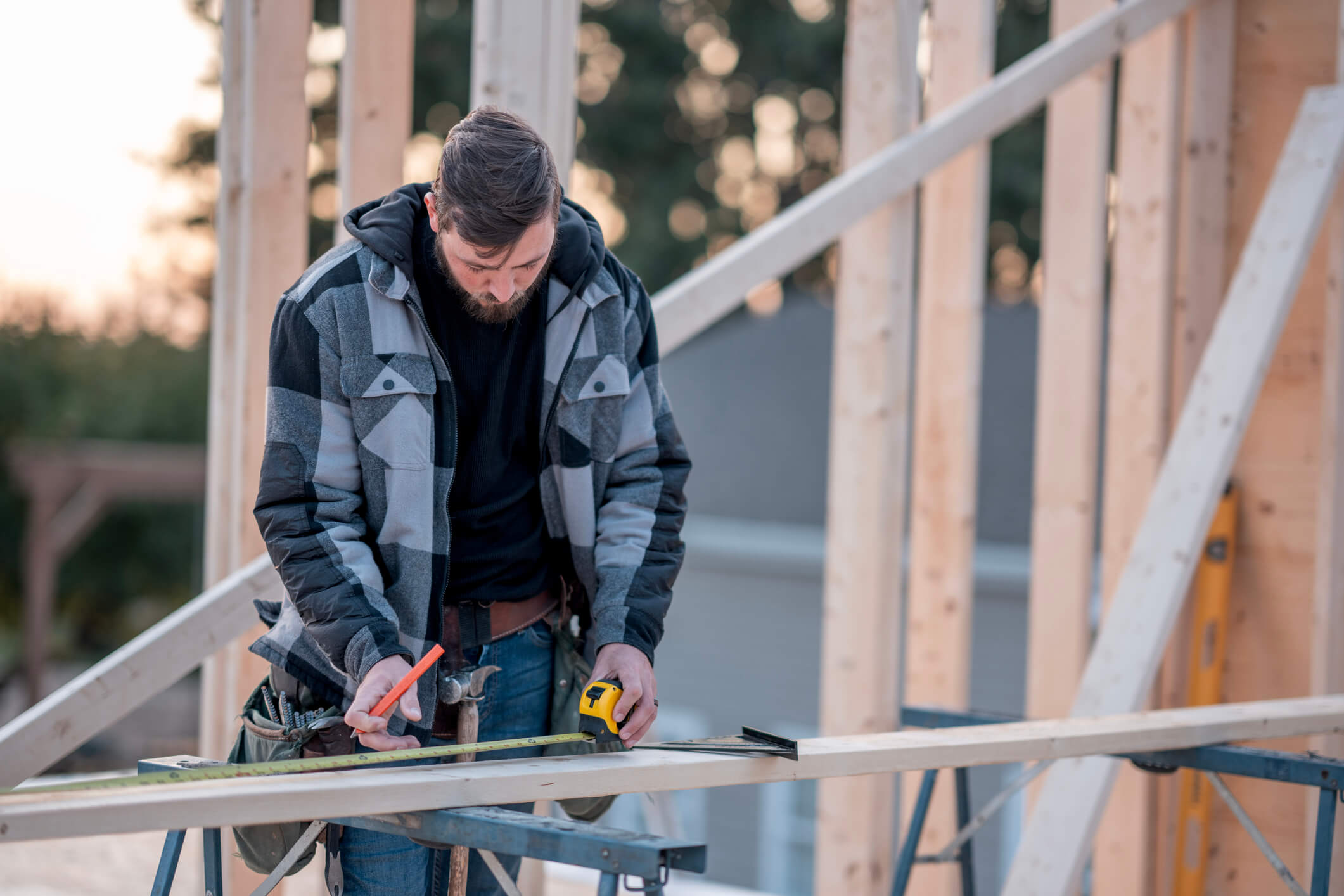
The construction workforce is bigger than it was during the housing boom.
Since 2005, the share of trades workers has dropped from 71% to under 59%, according to the National Association of Home Builders. Meanwhile, management, admin, and technical roles have surged.
On paper, that should make the industry more efficient, but it’s doing the opposite.
In principle, a larger presence of engineering and technology workers should support productivity gains through improved project design, coordination, and innovation. However, the expansion of management and business roles may also reflect increasing regulatory complexity, permitting requirements, and compliance costs, all of which can lengthen project timelines and raise overhead without directly increasing output.
The declining share of skilled trades workers, the group most directly responsible for on-site production, may also offset any productivity gains. Taken together, these compositional changes complicate the link between workforce structure and productivity.
Something doesn’t add up.
Over the past 70 years, most industries have figured out how to do more with less. Manufacturing is the clearest example—productivity has exploded. What once took days now takes hours. What once required hundreds of workers now runs on systems.
Housing didn’t follow that path.
We’re still building homes largely the same way we always have: on-site, piece by piece, exposed to weather, labor variability, and delays. Tools have improved. Materials have improved. But the system hasn’t.
And that’s where the story usually stops. “Construction just hasn’t innovated.” That’s too easy—and it’s wrong. Manufacturing scaled because it could. It happens in controlled environments where products are standardized, and processes are repeatable.
Housing is the opposite.
Every project is tied to a specific piece of land. Every jurisdiction has its own rules. Every build is exposed to a different set of constraints—zoning, permitting, inspections, and labor availability.
You’re not running a factory. You’re rebuilding one from scratch every time. And that has consequences.
It shows up in the data. Despite rising demand, the U.S. is still building fewer homes per capita than it did decades ago. Productivity in construction has barely moved. In some measures, it’s declined.
There’s still a massive opportunity here. Modular and off-site construction can help. Smarter systems can help. Better policy can help.
But none of it works in isolation.
Because the bottleneck isn’t just the method.
It’s the system that the method has to operate inside.
We don’t have a housing shortage because demand is too strong. We have a shortage because the system can’t move fast enough.
And in this market, speed isn’t a luxury.
It’s survival.