



Before you break ground, you’ve already made most of the important decisions.
The lot. The plans. The permits. The subcontractors. The construction budget.
Your exit strategy deserves that same attention.
Who will buy this home? How much cash will they need at closing? What happens to your margin if the sale takes longer than expected?
Those questions belong in the project plan while you still have time to act on the answers.
Start With the Buyer’s Budget
A projected sales price is essential to evaluating a deal. But it doesn’t tell you everything about the buyer’s ability to purchase.
Two households shopping at the same price point may face very different obstacles. One has a solid down payment but needs a manageable monthly payment. Another can handle the payment but needs to preserve cash for closing, moving, and everything that comes afterward.
Understanding your likely buyer helps you make better decisions about the home, its price, and how you bring it to market.
It also gives you a reason to involve a consumer mortgage lender early. Ask what financing options may fit your target buyers, what could prevent them from qualifying, and which incentives might address those obstacles.
Give Incentives a Place in the Budget
When a finished home sits, the pressure to do something builds.
A price reduction is visible and easy to communicate. It may also be the right response, especially if the home is priced above its competition, but it deserves comparison with other options.
Depending on the buyer and loan program, help with closing costs or an interest rate buydown may address a more immediate obstacle. Those possibilities are easier to evaluate when you have already built incentives into your project budget.
That allowance doesn’t commit you to spending the money. It gives you room to respond deliberately.
Ask your mortgage partner to show the buyer’s payment and cash to close under different scenarios. Then compare the cost to your business, including the carrying costs of waiting longer for a sale.
Know What Waiting Costs
From a lender’s side of the table, an unsold home is a running expense.
Interest continues to accrue. Taxes, insurance, and utilities keep arriving. If the sale stretches past the loan’s maturity, an extension can add fees and lead to harder conversations when you have the least leverage. Meanwhile, the capital tied up in that home isn’t available for your next start.
Consider a simple, hypothetical example.
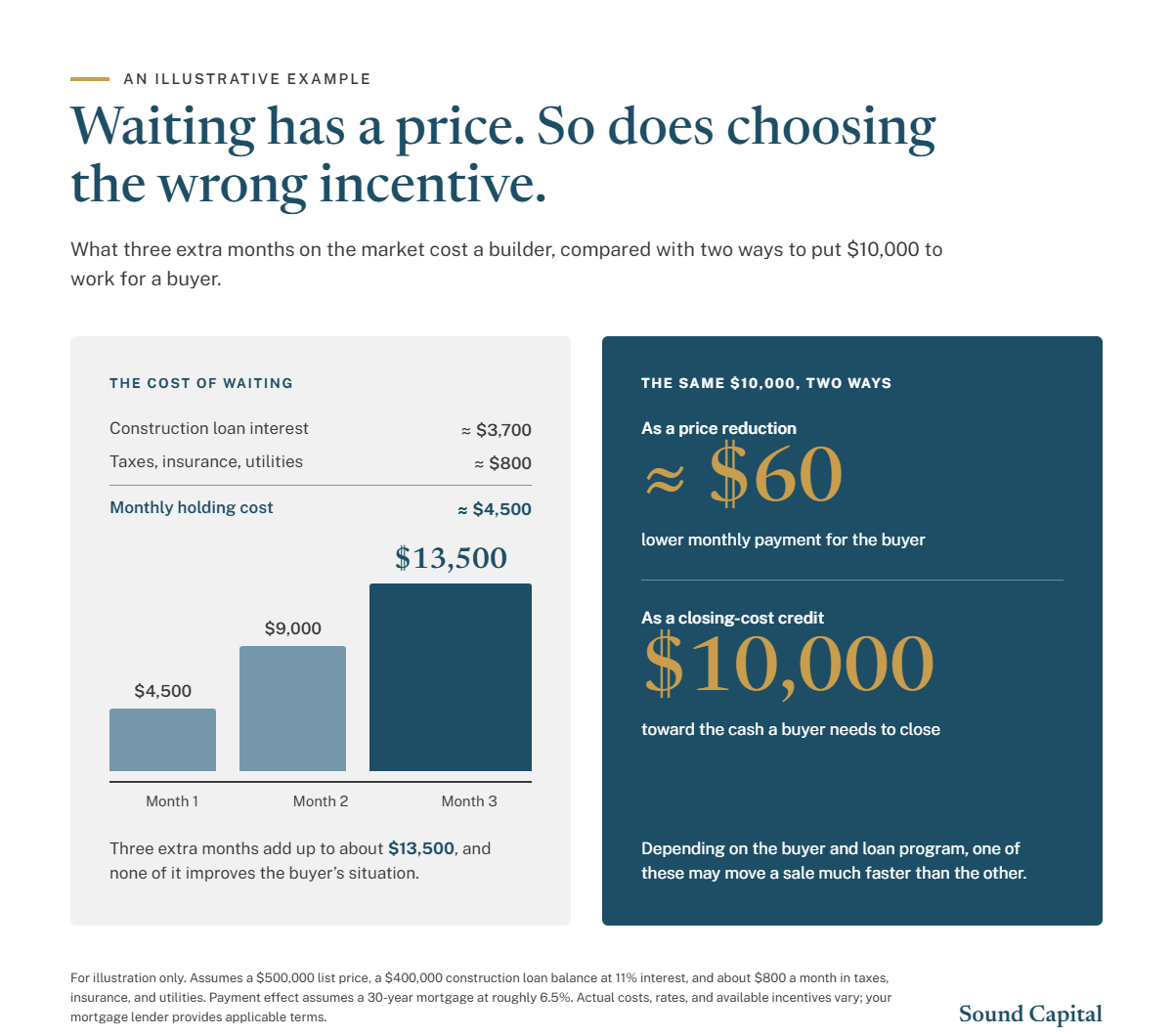
A builder has a $400,000 construction loan balance at 11% interest on a home listed at $500,000. Interest alone runs about $3,700 a month. Add taxes, insurance, and utilities, and holding the home might cost roughly $4,500 a month.
If the home sits an extra three months, that’s about $13,500, and none of it improves the buyer’s situation.
Now compare a $10,000 incentive offered at listing. As a price reduction, it might lower a buyer’s monthly payment by only about $60. As a closing-cost credit, the same $10,000 could cover much of what a cash-strapped buyer needs to close. Depending on the buyer and loan program, one of those may move a sale much faster than the other.
The exit belongs in the conversation before the loan closes. Talk through your expected sales timeline with your construction lender, along with what happens if it runs long. Those answers are easiest to act on while the project is still on paper.
Review the Exit as Construction Progresses
The assumptions that supported a project at acquisition can change before the home is ready. Competing inventory appears, mortgage rates move, and buyers respond differently than expected.
Set checkpoints during construction to revisit your anticipated price, likely buyer, sales timeline, and incentive budget. Include your listing agent and mortgage partner in those conversations. An early adjustment may give you more choices than a late reaction.
When you market the home, help buyers understand the offer’s practical value. A financing incentive needs a clear explanation of what it could mean for their purchase, with the mortgage lender providing the applicable terms.
A well-built home gives buyers something worth owning. A well-developed exit strategy accounts for what it takes to get there.
Builders cannot control every condition a home faces when it reaches the market. They can prepare the sale the same way they prepare the build.
You can’t control every condition a home faces when it reaches the market. You can prepare the sale the same way you prepare the build.
That preparation works best when it starts early. At Sound Capital, we talk through exit assumptions with builders when we underwrite a deal: who the buyer is, how long the sale might take, and what happens if it runs long. Those questions are cheapest to answer before the first shovel hits the ground.