


There’s a simple way to understand the housing market right now: Are we building enough roofs for every new household formed?
We’re not.
And we haven’t been for a long time. Let’s start with building permits.
At the peak in 1972, the U.S. issued 10.6 housing permits per 1,000 people. Today, we’re closer to 4.3 per 1,000—still 35% below the long-term average.
That gap matters because permits aren’t just paperwork. Their intent.
As the authors Manu Garcia and Carlos Garriga explained in a recent post on the Federal Reserve Bank of St. Louis’ On the Economy Blog, permits reflect how confident builders are about putting capital to work and how much future supply is actually coming.
And right now, that signal is not just weak—it’s deteriorating in real time.
New data from the NAHB’s Eye on Housing blog shows single-family permits fell 15.2% year over year to start 2026. That decline isn’t isolated. It’s happening across every region in the country—from the Midwest to the West. Even in top-producing states like Texas and Florida, permits are down double digits—right where builders have historically driven the most supply.
And multifamily? Flat. Holding steady, but not accelerating enough to close the gap. In other words, the pipeline isn’t just thin. It’s thinning.
To see why, you have to look at completions.
Permits lead completions by several months to a year—that’s the construction pipeline. What gets permitted today becomes tomorrow’s housing supply.
In 2024, completions (4.8 per 1,000) slightly outpaced permits (4.3 per 1,000), as projects from the post-pandemic surge finally worked through the system. But that’s backward-looking supply. The forward signal—permits—is still lagging.
Historically, this relationship holds.
In 1972, permits peaked at 10.6 per 1,000, with completions following at 9.5 the next year. In 2008, both collapsed together. And during the pandemic, permits surged in 2021—but completions lagged as supply chains broke and labor tightened.
The takeaway is simple: What we’re building today isn’t enough—and what’s coming next doesn’t suggest that’s changing.
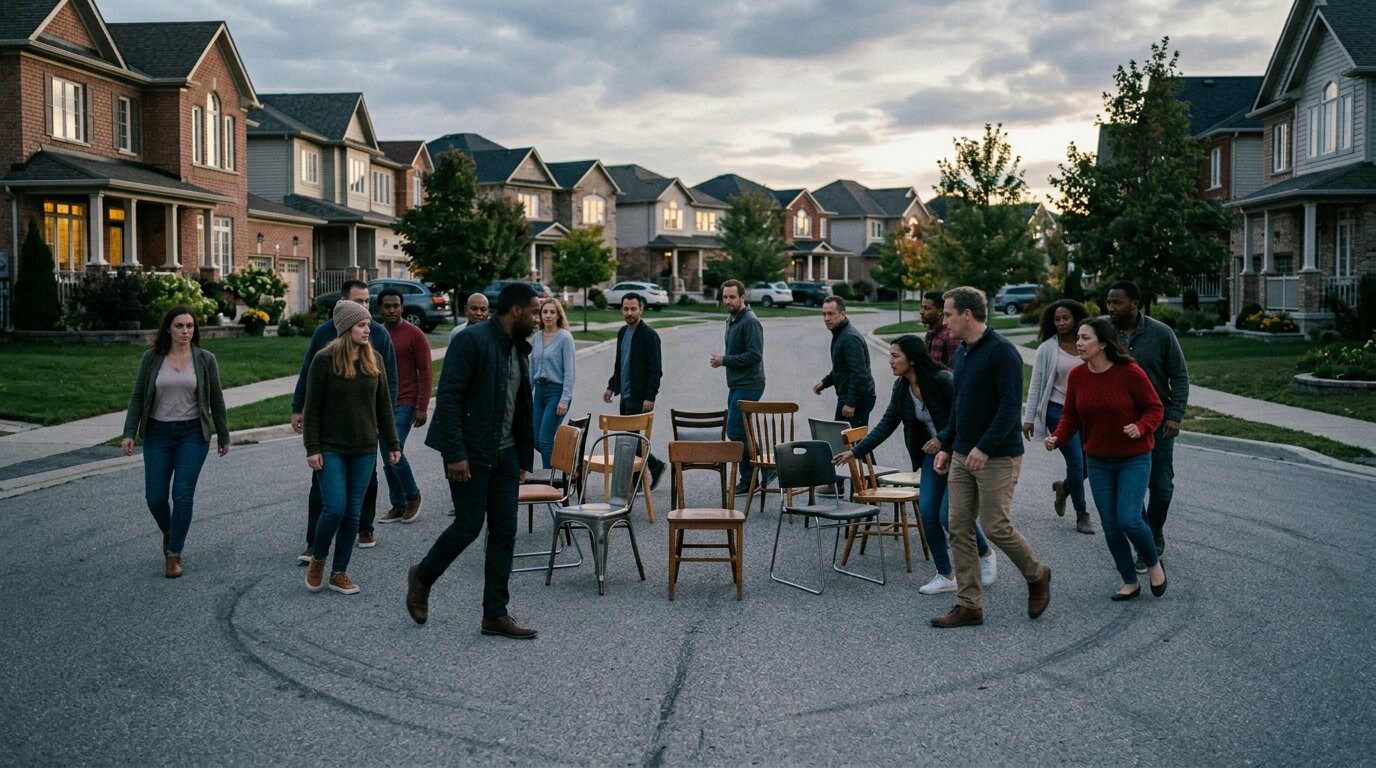
The Game of Musical Chairs
When supply falls behind household formation, housing doesn’t just get expensive. “It becomes a game of musical chairs in which the lowest earners are left without a seat,” Garcia and Garriga write.
That’s exactly where we are.
Since 2000:
- Home prices are up 207%
- Incomes are up 155%
That gap doesn’t close on its own. It compounds. So we did what markets always do under pressure—we stretched. More debt. More leverage. More people are reaching just a little further than they should.
Sound familiar?
This Isn’t the 1970s. It’s the 2000s All Over Again.
The easy comparison today is stagflation. It’s the wrong one. Look underneath. You’ve got:
- Weak wage growth
- Rising consumer debt
- Asset values doing the heavy lifting
That’s not the 1970s. Bloomberg argues that’s the mid-2000s. The last time we built an economy on top of fragile consumers and inflated assets, it didn’t unwind slowly.
It snapped.
The Psychological Shift No One Is Talking About
But this cycle has something new. People are starting to opt out. A new Harris Poll reveals that Americans, particularly Gen Z and Millennials, feel homeownership is “less like a goal and more like a privilege.”
That’s troubling. As is this statement:
“Among Americans earning over $200,000 a year, nearly half say you need a $300k income to afford a home. Not to afford a nice home. Just a home.”
That’s not just affordability. That’s belief, and when belief breaks, behavior follows. In fact, recent research suggests that when people conclude they’ll never own a home:
- They save less
- Spend more on short-term consumption
- Take more financial risks
- Invest less in long-term outcomes
That’s not a housing problem. That’s an economic one.
So What Happens Next?
Here’s where we are:
- We don’t have enough housing to bring prices down
- We don’t have enough income growth to support current prices
So the market does neither. It doesn’t crash. It doesn’t recover. It stalls. And while it stalls, something more subtle happens:
It filters.
The people who can afford to stay in the game … do. Everyone else adjusts, delays, or drops out entirely.
The Question Builders Should Be Asking
Not: “When does the market normalize?”
But: “How do you operate in a market that doesn’t normalize?”
Because this is the new constraint:
- Buyers are thinner
- Margins are tighter
- Capital is less forgiving
And the old playbook—wait for rates to drop, wait for demand to come back—doesn’t solve any of it.
What Actually Works Now
The builders who keep growing in this market aren’t waiting. They’re adapting. They:
- Build to what the market can actually absorb—not what it used to reward
- Structure deals to survive tighter margins and slower turns
- Treat capital as a strategic advantage, not a commodity
Because in a market like this, you don’t win by being right about the cycle. You win by being built for the constraint.