
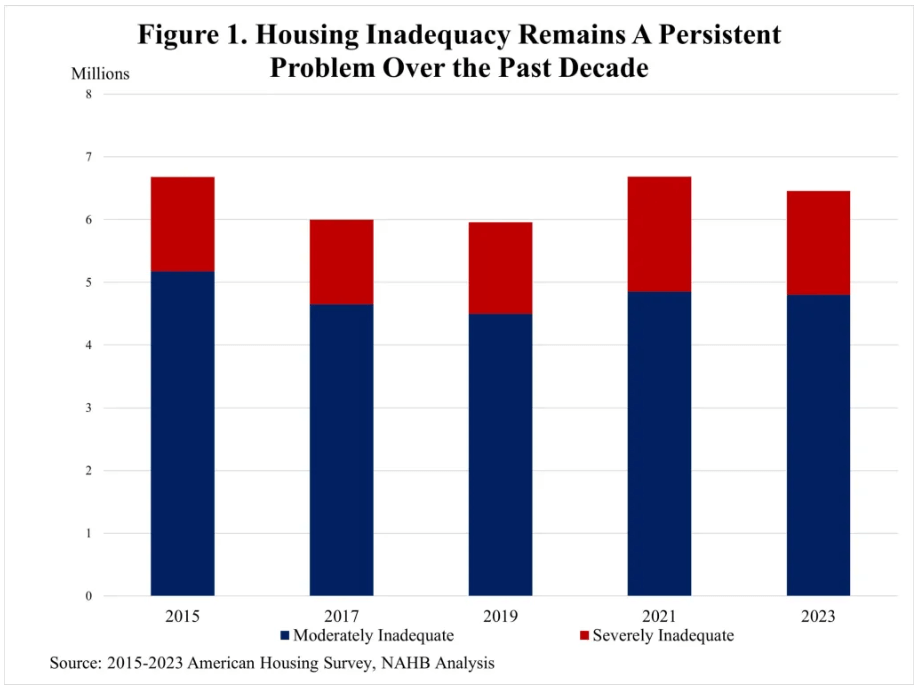
When people talk about the housing shortage, the conversation almost always turns to supply—how many homes we need to build and how fast we can build them. But new data from the American Housing Survey reveals a quieter problem hiding in plain sight: millions of existing homes simply aren’t up to standard.
In 2023, roughly 6.45 million U.S. homes—about 5% of the housing stock—were classified as inadequate under standards set by the U.S. Department of Housing and Urban Development. Of those, 1.65 million were deemed severely inadequate, meaning serious issues like failing systems, unsafe wiring, water intrusion, or missing basic utilities.
This isn’t just a story about neglect. It’s a story about aging inventory.
Homes built between 1960 and 1979 now account for the largest share of inadequate housing nationwide. These are not fringe properties. They’re the backbone of suburban America—homes with good bones, solid locations, and owners who often have equity but face mounting repair decisions.
Geography matters, too.
Smaller metro areas account for the largest share of inadequate housing, driven by older stock and lower reinvestment over time. Yet major metros still have a significant share of severely inadequate homes, underscoring that this challenge cuts across markets.
One of the most revealing insights: many homeowners living in inadequate housing are not severely cost-burdened. In other words, the issue isn’t always a lack of money—it’s uncertainty. Where to invest. Who to trust. Whether improvements are worth it in a volatile market.
For builders, remodelers, and investors, these data points to a durable opportunity. Not every housing problem is solved by new construction. In many cases, the next decade of housing demand will be met by those who can restore, replace, and reimagine the homes we already have.
